物联网分布式传感节点的广泛部署对长期自供能的微功率电源需求日益迫切。环境中普遍存在的低频振动能(<100 Hz)是理想的分布式能源,然而传统单一结构的压电能量收集器受限于窄带响应特性,难以在复杂多变的低频环境中实现高效能量转换。
针对上述痛点,武山教授课题组周晶晶老师带领本科生倪凯迪、张磊,构建了“理论建模-仿真分析-实验验证”一体化研究框架。研究的核心创新点包括:从集总参数法出发,建立了耦合阵列系统的动力学控制方程,揭示了弹性主梁通过“双向泵送”效应实现模态间能量再分配的物理机理;系统推导了串并联拓扑下的电路模型,量化分析了串联拓扑中相位不一致导致的电压矢量相消效应以及并联拓扑中支路电势不匹配引发的内部环流损耗,从理论上阐明了两种拓扑的适用边界;提出了“串联升压、并联拓频”的定向设计策略,建立了“结构-电路-应用”之间的映射关系。
据此制备的七梁耦合阵列器件在1g(9.81 m/s²)加速度激励下展现出优异的综合性能。实验结果表明:串联连接方式下,系统最大输出电压达14.1 V,最大输出功率达1.48 mW,较单梁结构提升约65.3%;并联连接方式下,系统有效工作带宽拓展至19 Hz,为单梁的5.75倍。这种基于串并联的灵活运用策略,实现了根据实际应用需求定制化能量供给的目标,为多元低频环境下的自供能系统提供了一种创新的、具有普适性的新方法。
相关成果“Design and application of series/parallel configuration for coupled cantilever array piezoelectric energy harvester in low-frequency environments”发表在SCI期刊《Smart Materials and Structures》(JCR二区,IF=3.8)。本科生倪凯迪和张磊为共同第一作者,周晶晶老师为通讯作者。该研究提出的耦合悬臂梁阵列压电能量收集系统,能够依据外部振动特性自适应选择电气连接策略,实现高效能量捕获,为微型电子设备的供能难题提供了具有良好适应性的解决方案。(撰稿:倪凯迪)
文章链接:https://iopscience.iop.org/article/10.1088/1361-665X/ae8a22
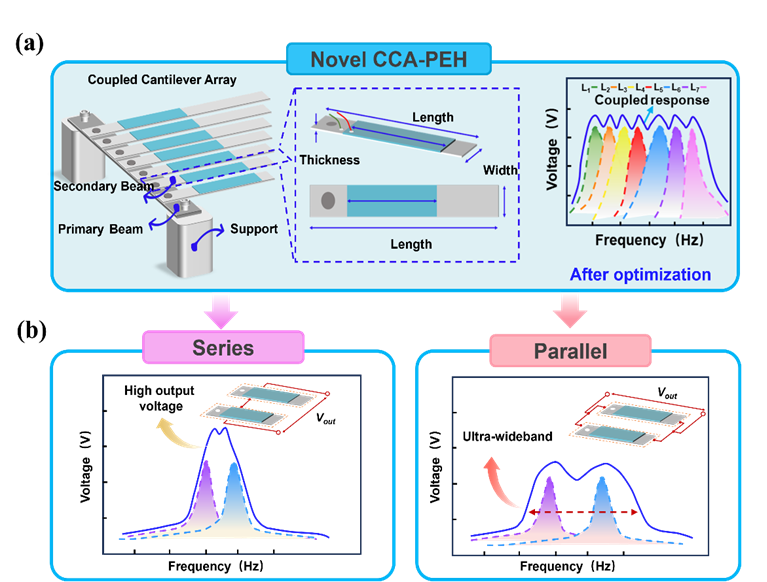
Fig. 1.Schematic diagrams of the piezoelectric energy harvester design: (a) Harvester model and its corresponding optimized output schematic; (b) Harvester configurations employing two distinct electrical connection strategies.
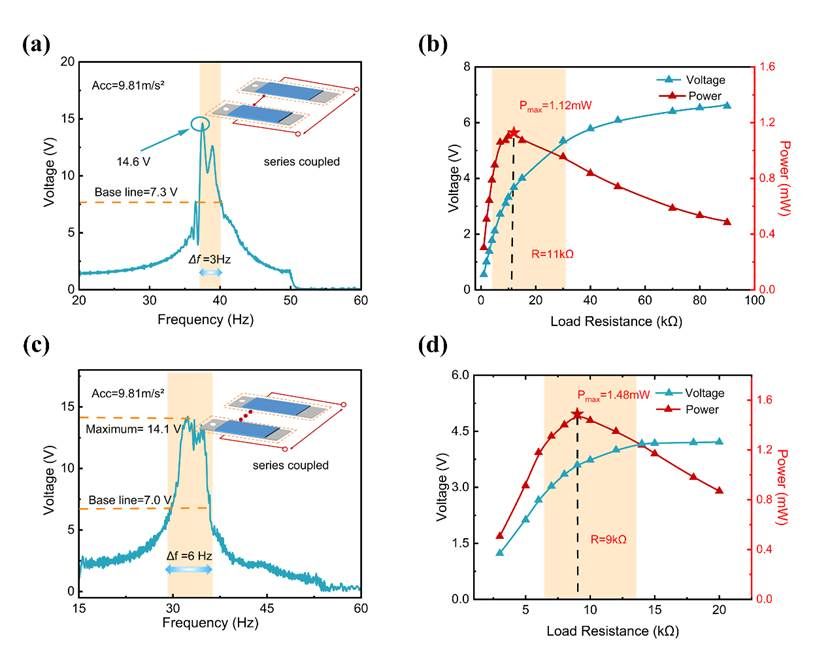
Fig. 2.Output characteristics under series coupled connection: (a) Voltage response of the two-beam coupled cantilever array; (b) Power response of the two-beam coupled cantilever array; (c) Voltage response of the seven-beam coupled cantilever array; (d) Power response of the seven-beam coupled cantilever array.
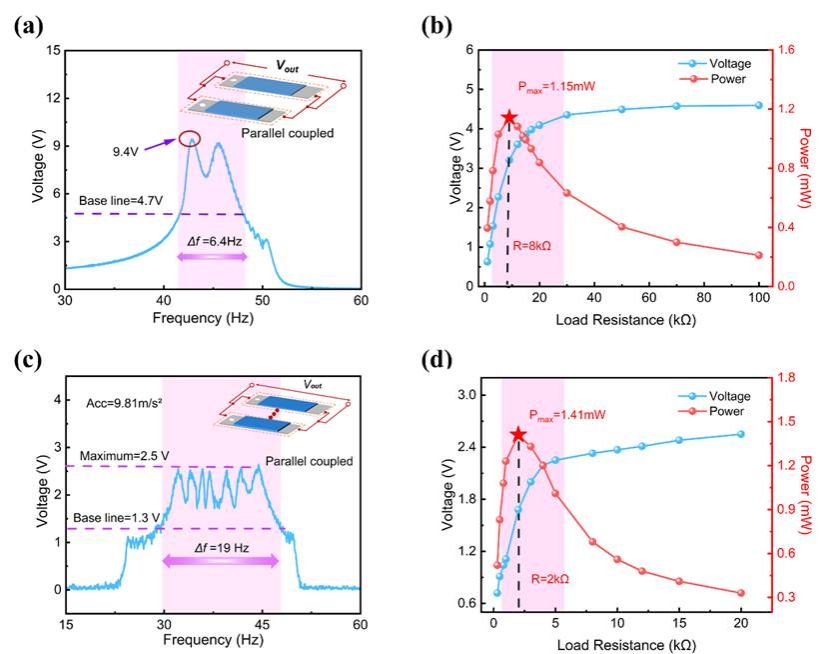
Fig. 3.Output characteristics under parallel coupled connection: (a) Voltage response of the two-beam coupled cantilever array; (b) Power response of the two-beam coupled cantilever array; (c) Voltage response of the seven-beam coupled cantilever array; (d) Power response of the seven-beam coupled cantilever array.